AP Physics 1 2026 Scores Are Out: What the Higher Pass Rate Actually Means
The numbers, side by side
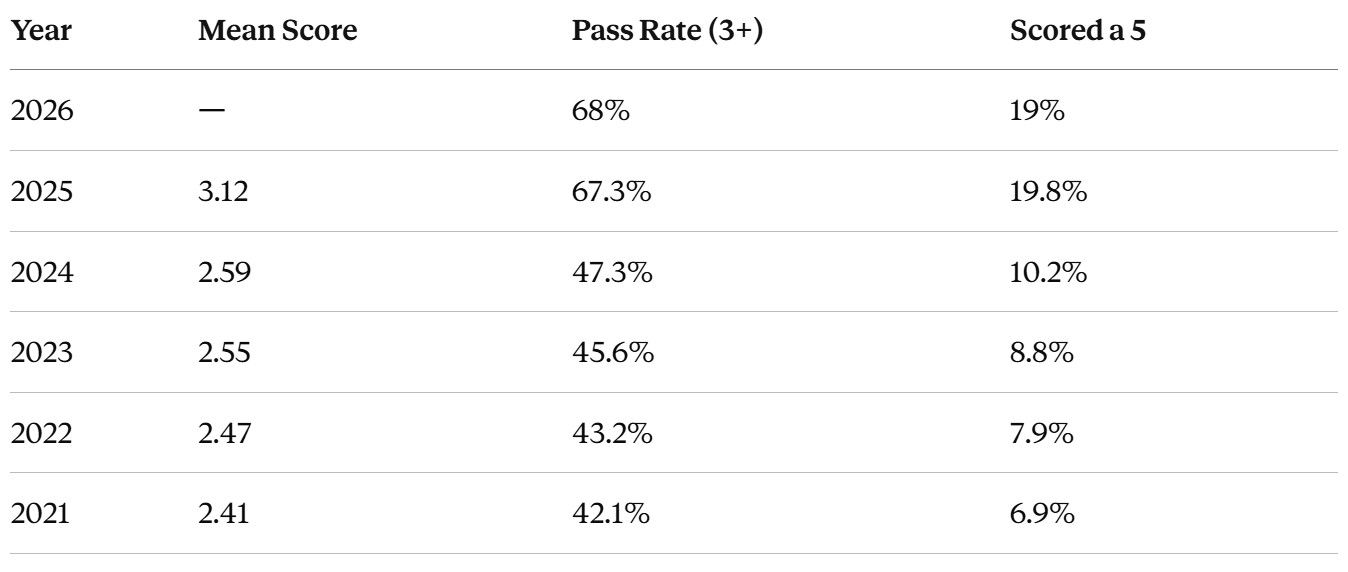
Score distributions from the College Board. 2026 mean and test-taker totals are still being finalized as scores roll out.
What actually changed: a redesign, not a curve
- Multiple-choice dropped from 50 questions to 40, while the time only fell from 90 to 80 minutes - so you now get about 2 minutes per question instead of 1.8.
- The dreaded "multiselect" questions (pick two correct answers or get zero) were removed entirely.
- Free-response dropped from 5 questions to 4, and the time increased from 90 to 100 minutes - roughly 25 minutes per FRQ.
- The exam moved to a hybrid digital format: multiple-choice is now answered in the College Board's Bluebook app, while free-response answers are still handwritten in paper booklets.
- The old open-ended "paragraph argument" FRQ was eliminated and replaced with four clearly defined FRQ types: Mathematical Routines, Translation Between Representations, Experimental Design & Analysis, and Qualitative/Quantitative Translation.
Is a 3 still worth something? Yes - but understand why
This is the fair question, and skepticism here is healthy. If the pass rate jumped 20 points overnight, it's reasonable to wonder whether a 3 in 2026 quietly means less than a 3 in 2023.
The honest answer has two parts, and both matter.
Part one: some of the increase came from a new standard-setting process, not just an easier-feeling test. Alongside the redesign, the College Board moved to a revised, evidence-based method for deciding where the score boundaries fall. In plain terms: they re-examined what level of demonstrated understanding should correspond to a 3, a 4, a 5 - and their research concluded the old cutoffs were set too harshly - students scoring just below the old boundaries were outperforming college students who'd earned passing grades in the equivalent courses. So part of the jump is a correction, not a gift. Many students who would have scored a 2 under the old boundaries were arguably demonstrating qualified, college-ready understanding all along; the previous exam just wasn't giving them credit for it.
Part two: the standard a score represents is set by the College Board, not by the raw pass rate. A 3 is defined as "qualified" - meaning you've shown you could handle the equivalent introductory college course. That definition didn't change. The College Board's whole job in equating and standard-setting is to keep that meaning stable across years and formats. A college awarding credit for a 3 is trusting that definition, not a percentage.
So here's the balanced take. Does a higher pass rate mean your 3 is worthless? No. It means the exam stopped penalizing students for reasons that had nothing to do with physics - cramped timing and punishing question formats — and started measuring understanding more cleanly. A 3 still says "this student can do college-level physics." What changed is that the exam finally lets more of the students who can actually prove it.
In fact, the College Board states this outright: AP exams are not graded on a curve. They're criterion-referenced — every student who meets the bar for a 3, 4, or 5 receives that score, no matter how many students clear it. A rising pass rate doesn't dilute anyone's score, because scores were never rationed in the first place. More students passing simply means more students demonstrated the standard.
The one honest caveat: because a 4 and 5 are also more attainable now, the competitive value of any given score has compressed a little. When more students earn 4s and 5s, a 5 stands out slightly less on a college application, and selective schools that already required a 4 or 5 for credit haven't loosened up. So the floor got more reachable, but the ceiling got more crowded. If your goal is credit at a competitive university, aim for a 5 - that hasn't changed.
What this means for how you prepare
The redesign quietly rewired the right way to study for this exam, and this is where a lot of students are still losing points to outdated habits.
Stop optimizing for speed, start optimizing for reasoning. The old exam punished you for being slow. The new one gives you room to think - which means it rewards students who genuinely understand the why and can show their work clearly. Plug-and-chug muscle memory was always a weak strategy on Physics 1; now it's an even weaker one.
Learn the four FRQ types as distinct skills. This is the biggest strategic shift. Because the free-response section is now standardized into four defined archetypes, you can prepare for each one specifically instead of hoping for the best. Knowing exactly what a "Mathematical Routines" question asks you to do - versus an "Experimental Design" or "Qualitative/Quantitative Translation" question - is worth real points. Practicing them as separate moves is far more effective than doing random full FRQs - it's exactly why we built every lesson at Physics On Track to drill each FRQ type in isolation until its structure becomes automatic.
Don't skip Fluids. Unit 8 is new, worth 10–15%, and frequently rushed or skipped by teachers who ran out of year. Many students walk in underprepared on buoyancy and Bernoulli specifically because their prep materials predate the change. That's a free letter grade sitting on the table for anyone who prepares it properly - so whatever prep you use this year, make sure it treats Fluids as a full unit, not an afterthought bolted onto old material.
Throw out pre-2025 materials. Any calculator, practice test, or study guide built on the 50-question / 5-FRQ format is now actively misleading. The scoring math, the timing, the question types, and the content all changed.
Starting the course this fall? Here's your exam - the May 2027 format
- Multiple choice: 40 questions → 42 questions, with time increasing from 80 → 85 minutes.
- Free response: section time decreasing from 100 → 95 minutes (still 4 questions).
At first glance this looks like "more MCQs, less FRQ time," but the details soften that considerably, and the net effect on how hard the exam feels is minor:
Those two extra MCQs almost certainly aren't scored. The College Board's standard practice - now consistent across all four AP Physics exams - is that of the 42 multiple-choice questions, only 40 count toward your score. The other two are unscored field-test items being trialed for future exams. So your scored multiple-choice length isn't really changing; you're just answering two questions that don't count, which is why the section gets five extra minutes. Your per-question pace stays right around 2 minutes.
The FRQ trim is 5 minutes across four questions. Losing 5 minutes off a 100-minute section is real but small - a little over a minute per question. It rewards students who've internalized the four FRQ types and can move efficiently into each one, rather than staring at a blank page deciding how to start. This is exactly why practicing each FRQ archetype as a distinct, rehearsed move matters more than ever: on a slightly tighter clock, hesitation is what costs points, not lack of knowledge.
The bigger picture: none of this reverses the 2025 redesign. The student-friendly core - calculator on both sections, no multiselect, standardized FRQ types, generous per-question pacing - all stays intact for your exam. The 2027 change is a refinement, not a return to the old gauntlet. If anything, it makes the case even stronger for building genuine fluency with the FRQ formats early in the year, so timing is never the thing standing between you and the score you're capable of.
The bottom line
AP Physics 1 spent nearly a decade as a gatekeeper exam - one where roughly half of well-taught students walked away with a failing score, often for reasons that had more to do with test mechanics than with physics. The 2025 redesign fixed a lot of that, and the 2026 results confirm it's holding. More students are passing because the exam is finally a cleaner measurement of understanding - not because the physics got easier.
That's genuinely good news, and it should change how you approach the exam: study for deep conceptual reasoning, master the four FRQ types deliberately, and give Fluids the respect it deserves. Do that, and the redesigned exam is very much within reach.
Here's the honest truth about preparing for this exam: self-paced programs are great until you get stuck. Tutoring is great until you realize nothing sticks between sessions. Physics On Track was built to solve both — structured interactive lessons through all eight units (yes, including Fluids), deliberate practice on each of the four FRQ types, a 24/7 AI Learning Coach that gets you unstuck the moment you're stuck and live group and personal support, so momentum never dies between study sessions. If you're starting AP Physics 1 this fall for the May 2027 exam, the students who build FRQ fluency from day one — not in April — are the ones this redesigned exam rewards. Start your 7-day free trial and see if it fits how you learn.

Join the waitlist
On Track Guarantee Terms & Conditions
When AP Physics 1 Gets Hard: A Month-by-Month Guide for Parents